Wednesday, October 20, 2010

Glorious Garlic: Tips for Working with Fresh Garlic


I realize that sometimes it's easier to grab the granulated garlic shaker than to peel and chop a clove of fresh garlic but trust me the fresh garlic flavor and versatility make it worth the effort.


Always try to purchase garlic from the bulk bin versus bagged garlic. This helps to ensure that the garlic you buy is fresh. You can sort out the best garlic by following these hints. Always choose a large head of garlic with tightly packed cloves and white papery skin. Avoid garlic with loose cloves and damaged or discolored skin.

If you happen to purchase a head of garlic that has begun to sprout simply break the gloves apart and plant the in your garlic or window box. In a few weeks, you'll have garlic chives to snip.

Did you know that the finer you chop garlic, the stronger the flavor becomes? The oil in the garlic is released when you chop it, which gives the strong garlic aroma. A whole clove of garlic will impart milder flavor, while minced garlic will be more pungent.

Peeling garlic can be a hassle. If you are preparing a recipe that calls for whole garlic cloves like 40 Clove Garlic Chicken, try using a garlic peeler to remove the skin. If you don't have a garlic peeler, separate the cloves and place them in a small bowl. Pour boiling water over the cloves and allow to sit for 1 minutes. Drain the boiling water and then cover the cloves with cool water. When the cloves are cool, peel away the papery skin and use as desired.

I love the flavor of roasted garlic. Roasting mellows the sharp, pungent flavor and leaves you with creamy, aromatic goodness. It's wonderful in mashed potatoes, with roasted chicken, and in savory custards. It also makes a to-die-for accompaniment to cheeses and crackers. Try smearing it on crusty slice of French bread topped with goat cheese or cream cheese. Yum!
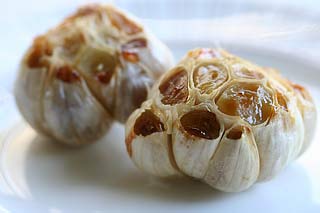

Roasted Garlic Heads

Roasted Garlic
Whole Fresh Heads of Garlic
Olive Oil

Preheat your oven to 350 degrees F. Cut off the top third (the stem end) of the head of garlic to expose the cloves. Leave the head in tact and attached by the root. Peel away any loose papery skin on the outside of the head. Place the heads of garlic in a ceramic container. Pour olive oil over the garlic until there is about 1/2 inch of oil in the bottom of the container. Cover the container with aluminum foil and bake for about 1 hour until the garlic is soft and lightly browned.

Carefully remove the softened garlic from the oil. The cloves should release the creamy garlic with a gentle squeeze.

You can also use the garlic-infused oil to make Caesar salad dressing, to sauté chicken or fish, or brush vegetables for grilling. Store the oil in the refrigerator for up to one week.

Tuesday, September 21, 2010

Redfield Farm Apple Butter


I just finished reading Redfield Farm, a novel about a Quaker woman and the underground railroad, written by my mother, Judith Redline Coopey.
(Incidentally, it's wonderful!) I don't know whether I was influenced by a passage in the book or by the crispness of the autumn air outside my window but I decided I wanted to make apple butter. 

Years ago my mother gave me an ancient, crumbling, Quaker cookbook from the 1800's that belonged to her mother. It only seemed fitting to consult it for a recipe for apple butter. I adapted this recipe from that book but streamlined it by incorporating a slow cooker. It's so simple and rustic, perfect for the new crop of fall apples in the markets. And, the smell of baked, tart apples and spices will fill your kitchen with autumn warmth. 

So, in honor of Ann Redfield the heroine of Redfield Farm,
and my mother, I present
Redfield Farm Apple Butter!

Redfield Farm Apple Butter
Makes 2 pints

2 pounds of Granny Smith Apples, washed, quartered and cored
1 cup water
1/2 cup sugar
3 inch cinnamon stick
4 whole cloves
4 whole allspice

In a large saucepan, combine the apples and water. Bring to a boil, and then reduce the heat and simmer until the apples have softened to the consistency of applesauce.

Pass the apples through a sieve or food mill.  Stir in the sugar and spices and pour the apple puree into a slow cooker. Set the temperature on low. Cover and cook, stirring occasionally, for 6 to 8 hours.

At this point you can can the hot apple butter in Ball jars, or simply cool the mixture and store it in the refrigerator for up to three weeks. 

Try it on a grilled cheese sandwich with sharp cheddar, alongside a pork roast, or smeared on toast!

Friday, September 17, 2010

Potato Pointers - Waxy vs. Starchy


Although you can use any potato you choose, you will get the best results following the suggestions below:
  • Use starchy potatoes like Russet/Idaho or Purple Potatoes for mashed, baked, roasted, and deep-fried potato recipes.
  • Use waxy potatoes like White Rose, Yukon Gold and Red Potatoes for sautéed/pan-fried, roasted, boiled, and potato salad recipes. If you use waxy potatoes for mashed potatoes, don't over mash them or they will get gummy.

Making your own French fries is simple and you will be giving your family a healthier alternative to commercial fries loaded with modified food starches and trans fats.

French Fries with Truffle Salt & Parmesan

Ingredients
4 large russet or other starchy potatoes, peeled or unpeeled
and cut into 3/8 by 3/8-inch thick sticks
2 quarts canola oil
Truffle salt or garlic salt
2 tbsp parmesan cheese

Directions
Heat oil over medium-low heat in a deep heavy pot* with a candy or deep-frying thermometer, or in an electric deep fryer, until the thermometer registers 275 degrees F.

Add the fries, in small batches, to the hot oil. Fry/blanch, stirring occasionally, until potatoes are soft and limp and begin to turn a pale blond color, about 5 minutes. Using a slotted spoon or fry basket, carefully remove fries from the oil. Spread the fries out on a cookie sheet in a single layer so they don't stick to one another.

When ready to serve the French fries, reheat the oil to 375 degrees F. Transfer the blanched potatoes to the hot oil and fry again, stirring frequently, until golden brown, about 2 minutes. Transfer to paper lined platter and sprinkle with Truffle Salt and parmesan cheese. Serve immediately.

*If you are frying in a heavy pot or Dutch oven, be sure that you have at least 3 to 5 inches of space between the top of the oil and the top of the pan so that the oil doesn't overflow when frying.

Note: Truffle salt is available at gourmet markets and specialty shops. If you don't find it in your neighborhood try substituting garlic salt instead.

Thursday, September 9, 2010

Blackberry Season is Here!


It's blackberry season! Chef Erin shares tips for storing fresh blackberries as well as a couple of her favorite recipes.


Savory Blackberry Sauce
for Salmon, Duck or Pork 
Serves 4

Ingredients
2 cups fresh or frozen blackberries
3 tbsp sugar
1/2 cup water
1 tbsp fresh lemon juice
2 tsp cornstarch or arrowroot powder
pinch of white pepper
1 tbsp unsalted butter, cold
1/4 tsp red wine vinegar

Directions
Simmer the blackberries, sugar and water in a saucepan until the berries are soft and starting to fall apart (about 5 minutes).Take off the burner and put the blackberries into a sieve. Use a wooden spoon or rubber scraper to push the berries through until you have extracted all the liquid. Discard the residue.

Put the liquid back into the saucepan and bring to heat. Whisk in the lemon juice, cornstarch or arrowroot, and white pepper. Heat until it begins to thicken slightly.

Remove from heat and whisk in butter and a dash of red wine vinegar. Add a little salt, if desired.

Spoon over roasted or grilled salmon and it's also wonderful on duck breast or pork tenderloin.


Blackberry Brandy

Ingredients
2 cups fresh, crushed blackberries
1 cup sugar dissolved in 1/2 cup boiling water
2 cups brandy, divided

Directions
Add sugar to boiling water and stir until dissolved. Gently crush the blackberries. Using your hands is fine! Pour the sugar water over the crushed berries.

Pour the mixture into a glass jar, add 1 cup brandy and seal the jar and shake gently. Place the jar in a cool, dark cupboard for 1 week. Strain the mixture through a fine sieve or cheese cloth. Add the second cup or brandy.

Sip on it's own or blend with vanilla ice cream for a decadent smoothie!

Wednesday, September 8, 2010

Lavender & Anise Seed Crusted Rack of Lamb with Goat Cheese Custards

Sometimes inspiration strikes at the most unexpected moments. That's what happened when I was trying to develop a recipe for a Grenache for a Buscador Wine. I had been experimenting with berry infused sauces and spicy dishes but hadn't happened upon that "ah ha" moment I was looking for. With just a tiny bit of wine in the bottle and the afternoon drawing to a close, I decided to call it a day. I went to my refrigerator and pulled out a tiny wedge of Rollingstone Creamery's Anise and Lavender Goat Cheese, smeared it on a cracker, took a sip of the remaining wine and - Blamo! - discovered my muse.


The next day I created this Lavender & Anise Seed Crusted Rack of Lamb with a Goat Cheese Custard. The lavender highlighted the floral qualities in the wine while the acidity of the goat cheese balanced the dryness and tannins of the wine.

Grenache on it's own is not a common wine. It's typically used in Rhone-style blends. If you are interested in learning more about Grenache, check out my blog in the wine section of the SheSpeaks Special Edition or The Wine Pairing Chef blog.

As we creep toward Fall, I envision a dinner table with candles, a cozy autumn meal. I find myself craving roast meats and creamier side dishes. This recipe fits the bill. Trying pairing it with a Grenache or another Rhone-style dry red wine.


Lavender & Anise Seed Crusted Rack of Lamb
with Goat Cheese Custard

Lavender & Anise Seed Rack of Lamb with Goat Cheese Custards
Serves 4

4 teaspoons dried culinary lavender
2 teaspoons anise seeds
1/4 teaspoon dried thyme
1/2 teaspoon kosher salt
1/2 teaspoon freshly ground black pepper
4 teaspoons olive oil
2 1 1/4 -1 1/2 pound racks of lamb, trimmed

Preheat oven to 400°F.

Combine all ingredients in small bowl. Smear paste over meat portion of lamb.

Place lamb, paste side up, in small roasting pan or baking sheet. Roast lamb until thermometer inserted into lamb registers 135°F for medium-rare, about 25 minutes. Transfer racks to a cutting board, lightly tent with aluminum foil and let rest 10 minutes.

Cut lamb between bones into chops and serve with Goat Cheese Custards (recipe below).

Goat Cheese Custards

3/4 cup whole milk
1/2 cup heavy cream
3.5 ounces goat cheese
1/2 teaspoon salt
1/8 teaspoons white pepper
1/4 teaspoon garlic powder
2 large eggs
2 egg yolks

Preheat oven to 325°F.

Add milk, cream, salt, pepper and garlic powder to a heavy sauce pan. Crumble in goat cheese. Bring mixture to just a boil, stirring constantly. The goat cheese should be melted and smooth. Remove pan from heat.

Whisk the eggs and egg yolk in a medium bowl until smooth and creamy. Slowly whisk in hot milk until well combined. Strain mixture into a pitcher and then divide among 4 ramekins.

Place ramekins into a roasting pan and pour in enough boiling water to come halfway up the sides of the ramekins.

Bake custards for 25 minutes until set. (To confirm, insert a sharp knife into the center of one custard. If the knife comes out clean, the custard is cooked.) Remove from roasting pan and let cool while roasting the racks of lamb.

To turn out, run a sharp knife around the edge of the ramekin to loosen the custard. Gently invert the ramekin onto the serving plate. Custard should slide out, if not, lift one edge and use a knife to coax the custard loose.

Monday, August 30, 2010

Gluten-Free Beer Battered Fish

With all the focus on gluten-free diets, I thought I'd take a stab at a recipe that you don't normally find G-Free alternatives for. This gluten-free beer battered fish rocks! Honestly, I'd challenge anyone to detect a difference in taste between this batter fish and one made with regular flour!


Gluten-Free Beer Battered Fish
Ingredients:
Oil for deep-frying (about 6 cups)
1 1/2 lbs skinless fish fillets like cod, flounder or talapia
3 tbsp Old Bay Seasoning
Salt & Pepper to taste

For Batter
1 cup Bob's Red Mill Gluten Free All-Purpose Flour
1 cup cornstarch
3/4 tsp xanthum gum
1 12 oz gluten free beer* or 12 oz club soda
1 large egg
1 tsp kosher salt

Combine the flour, cornstarch, xanthum gum, G-free beer or club soda, egg and salt in a large mixing bowl. Whisk well. Cover and refrigerate for at least 20 minutes.

Heat oil to 375 F in a deep Dutch oven or deep fryer.

While the oil is heating, pat fish fillets dry with paper towels. Season with Old Bay Seasoning, salt and pepper. Drop the fillets into the batter and toss to coat evenly.

When the oil is hot, lift the fillets one by one into the batter with tongs. Let excess batter drip off before lowering the fillets into the oil. Tip: Swish the fillets back and forth in the hot oil for a few moments before letting go.  It helps to prevent sticking to the pot or fryer basket. Fry until the fillets are golden brown, about 5 to 8 minutes. Serve with tartar sauce and lemon wedges!

*There are a number of Gluten-Free Beers on the market these days.  I've tried the recipe with Bard's The Original Sorghum Malt Beer (formerly Dragon's Gold).

Tuesday, August 10, 2010

Fresh Herb Focus: Parsley

As seen on SheSpeaks.com/Special Edition August 6, 2010


When you think of parsley, do you think garnish? Poor parsley...relegated to the edge of our plates, just a touch of color -- nothing more. (Sigh.) Well, here's bit of trivia for you, just 2 tbsp of parsley gives you 150% of your rda of Vitamin K and almost 17% of the recommended Vitamin C. It's a natural breath freshener and, besides that, according to ancient beliefs a wreath of parsley wards off drunkenness. (Sorry I can't be held responsible for the efficacy of either wives' tale, if you choose to test them.)

There are two kinds fresh parsley available commercially - curly and flat leaf a.k.a. Italian parsley. Flat leaf parsley has a slightly stronger flavor than curly parsley but they are otherwise interchangeable. Both have a slightly peppery flavor with hint of celery. In addition, parsley is nearly the least expensive fresh herb, which is always a bonus.

Now how about a few ways to use it? Toss minced parsley with buttery new potatoes or piping hot french fries for an herbaceous bump. Try a Tabbouleh Salad with minced parsley, couscous, cucumber and tomato. Use parsley stems in your homemade stock to impart flavor without coloring the broth. Make Persillade, a French combination of parsley and garlic, for fresh fish or oysters.

My favorite parsley recipe is an Argentinean sauce called Chimichurri. The Argentines are famous for their barbecuing, and this sauce is the perfect match for a juicy steak or grilled chicken. Since it's barbecue season, I thought I'd share the recipe with you. I suggest you try it with a glass of Argentine Malbec - not enough to warrant a parsley wreath, mind you!


Chimichurri

1Tbsp dried oregano leaves
2 Tbsp water
1 bunch fresh flat-leaf parsley leaves, remove the thickest stems
6 garlic cloves, peeled
3/4 cup extra-virgin olive oil
2 tsp kosher salt
1 tsp ground black pepper
1/4 tsp red pepper flakes
3 Tbsp sherry vinegar*

Directions:
In a small bowl, combine dried oregano leaves and water. Stir and let stand for 15 minutes. In the meantime, wash the parsley by placing it in a bowl of cold water and swishing it around. Dry the parsley by patting it with paper towels or spinning it dry with a salad spinner. After the oregano is moistened, combine it with parsley and garlic in a food processor. Process until the parsley and garlic are finely minced, about 3 to 5 minutes. Next, transfer the parsley mixture to a small bowl and stir in the olive oil, kosher salt, black pepper and red pepper flakes.

At this point you can refrigerate the chimichurri for up to 3 hours. Allow it to return to room temperature before you serve it. When you are ready to serve, simply stir in the sherry vinegar.

*For me, the sherry vinegar really enhances this dish but if it's not available in your local supermarket you can substitute red wine vinegar.

How many of you buy only dry parsley? Can you think of other ways to use fresh parsley?